The VO2 max challenge
Get a fair VO2 max target for your age, and 12 weeks to beat it.
Put in your age, your sex and the VO2 max your watch gives you, and you get a target that's about as hard for a 60 year old as it is for a 30 year old. I'm doing it as well, and I'm not drinking until my watch says 51.
Join the board
The board
It's ranked by how much of your own target you've done, so a 55 year old on an Apple Watch and a 28 year old on a Garmin are in the same race.
- ★
Lewis
0%
30s · Garmin
No alcohol until 51
- Start
- 45
- Now
- 45
- Target
- 51
Nobody else is on it yet.
Why I'm doing it
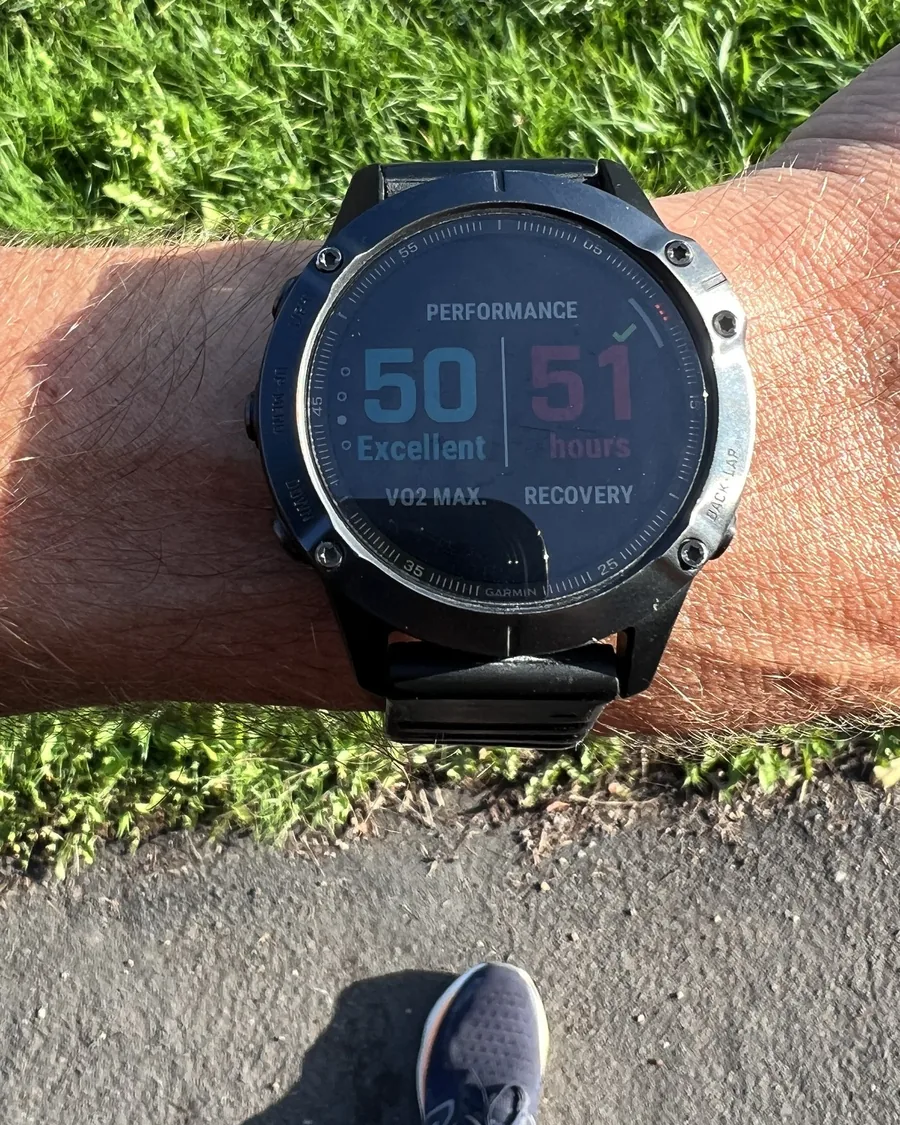
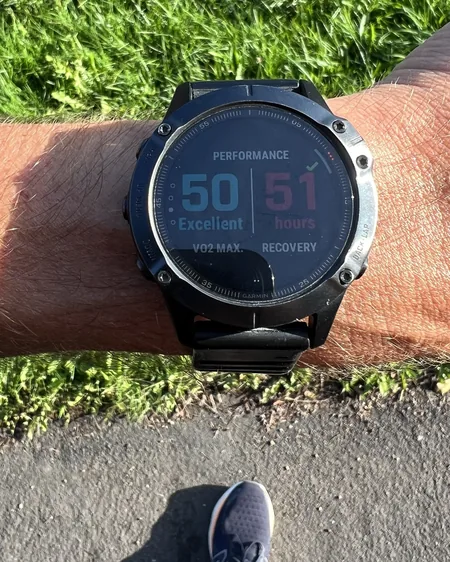
Three years ago I completed an Ironman in 14 hours. I trained for a really long time and I got my VO2 max to 50.
Since then a lot's happened. My muscle disease has caused me issues, and the summer my daughter was born I had some of the worst muscle damage of my life, probably in some part due to the stress of it and an emergency flight back to Europe from Bali because she came early. I'm still working with specialists to understand why I can't lift weights and why my muscles get damaged from very little strength training.
So the combination of being a new dad and dealing with these health issues means my health's taken a huge hit over the last couple of years. My VO2 max dropped all the way to 42, my exercise has been inconsistent, I haven't had any clear goals, and I've picked up some unhealthy habits again.
And in an effort to get back to being in the best shape of my life, what's always worked for me is setting very clear goals and challenges, so this is my latest one. I'm taking on no alcohol until I beat my previous all-time best, so my watch has to show 51, and I'm aiming to do it by my birthday on 19 February.
- On my watch now
- 45
- No alcohol until
- 51
Starts Tuesday 24 November
What actually raises it
I've nerded out on all of this. I co-founded a blood work company, I've had my own triathlon coaches, and it's probably a thousand hours of research and speaking to experts, so I'm reusing all the stuff that got me fit in the past.
- 01Four minutes hard, four times. It's four minutes hard, then three minutes of easy jogging, and you do that four times. Hard means about 90 to 95% of your max heart rate, so it isn't a flat-out sprint, you've got to be able to hold it for the full four minutes. In the Norwegian study it comes from, people did it three times a week for eight weeks and their VO2 max went up about 7%, which was more than the groups doing the same amount of work at an easier pace.
- 02Everything else long, slow and easy. Runs where you could hold a conversation the whole way. In a nine-week study of trained endurance athletes, the group that did mostly easy training with a bit of very hard training improved the most, nearly 12%, ahead of the groups that only went easy, only went hard or sat in the middle.
- 03Sleep. When studies cut people's sleep their endurance drops, and the longer the effort the bigger the drop, so I think the training only works if you're sleeping properly.
- 04HRV. It's the number your watch gives you in the morning for how recovered you are. The studies say training by it works at least as well as following a fixed plan, so if yours is low, I'd probably make that day an easy one.
- 05Alcohol. A Finnish study of about 4,000 people wearing heart monitors found that even a small amount cut how much their bodies recovered in the first hours of sleep, and a heavy night cut it by about 39 points on the study's recovery scale.
- 06Food. I'd say eat some carbs before the hard session so you can actually hit the heart rate, and get protein in with your meals. Your VO2 max is also measured per kilo, so if you've got weight to lose, that moves the number on its own.
If you follow along and do the same, I think it should get your number moving, but I can't promise it will. It isn't medical advice, so if you've got a health condition talk to your doctor first.
The studies · 4x4 intervals, 2007 · easy and hard mix, 2014 · sleep, 2023 · training by HRV, 2021 · alcohol and recovery, 2018
How the target is worked out
Garmin prints a table in its watch manuals, from The Cooper Institute, that shows what the top 5% of people score at each age, for men and for women. Your target is a percentage of your own number, and the further you are below that top 5% line the bigger the percentage, from 3% if you're already up there to 15% if you've got a long way to go. So a 30 year old man on 30 gets 5 points and a 60 year old man on 50 gets 2. A big review of 28 training studies found people gained about 5 points on average from a block of training, so these are meant to be strong targets. Your weight is already in it, because VO2 max is measured per kilo.
The rules
- 01Use the number your own watch gives you, and stay on the same watch the whole way.
- 02It starts on Tuesday 24 November, and you've got 12 weeks from then, or from the day you join if that's later.
- 03Put your new number in every two weeks with a screenshot. I'll email you a reminder.
- 04The board ranks how much of your own target you've done, not who has the biggest VO2 max.
- 05There aren't any prizes yet.
- 06None of this is medical or training advice. If you've got a health condition, talk to your doctor before you start pushing.